Plywood Equal Rip-Width Chart: 2 to 8 Strips From a 48-Inch Sheet
Find the maximum equal rip width for two through eight strips from a 48-inch plywood sheet with 1/16, 3/32, or 1/8-inch saw kerf.
Dividing 48 inches by the number of strips works only when blade width is zero. Every internal cut removes material, so three equal rips from an exact 48-inch usable width must be narrower than 16 inches. This chart reserves one measured kerf between adjacent finished strips, assumes no edge trim, and rounds displayed shop fractions down to the nearest 1/64 inch so the listed fraction does not exceed the calculated maximum.
Use the equal-rip formula
Subtract every known loss before dividing the remaining width. For n equal strips, there are n − 1 internal kerfs between them. Edge-squaring cuts are separate: subtract the total width removed from both outer edges before applying the strip formula.
The formula returns the mathematical maximum for the assumptions entered. In the shop, choose a target at or below that value, verify the first strip, and account for fence setup, sheet variation, and the finish tolerance your project requires.
equal width = (usable width − edge trim − [(n − 1) × kerf]) ÷ nusable width = measured sheet width before the planned ripsn − 1 = internal blade paths between n finished stripsThis model treats the two outside sheet edges as boundaries, not blade paths. Deliberate cleanup cuts belong in edge trim.
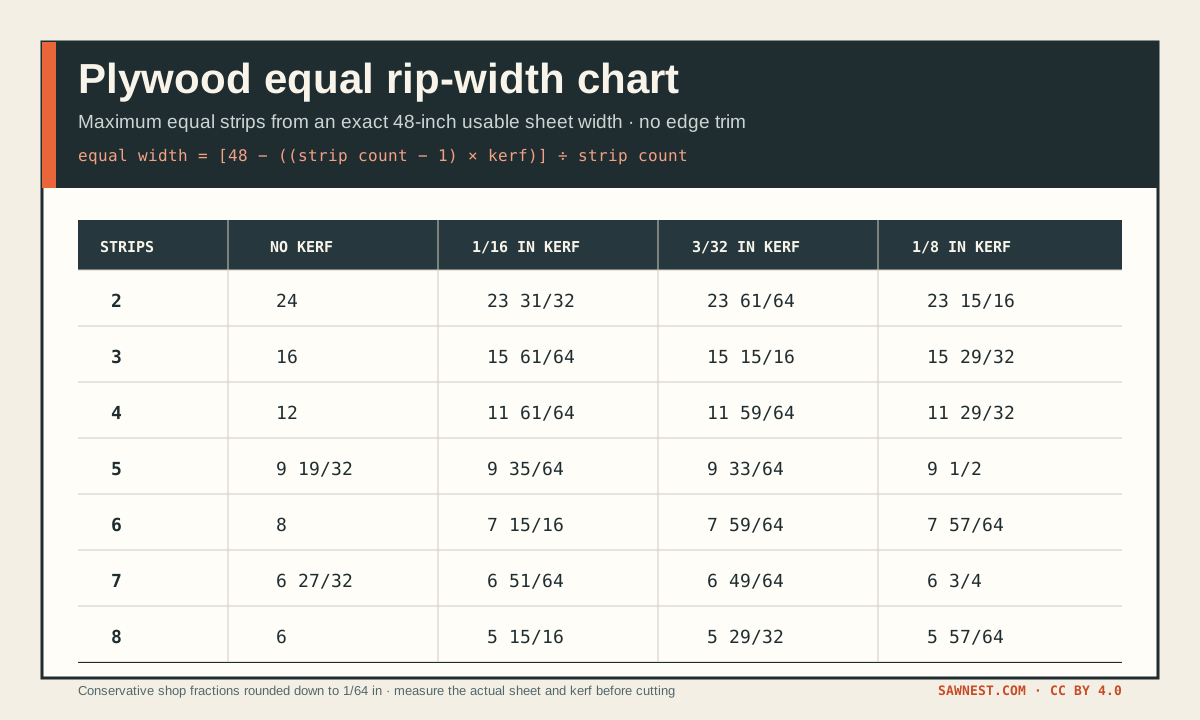
Equal rip widths from an exact 48-inch sheet
The fractions below are conservative shop references rounded down to the nearest 1/64 inch. The downloadable CSV keeps the unrounded decimal calculations to five places. A nominal sheet may not measure exactly 48 inches, so use the table to plan and the formula to finalize.
Boundary cases are the reason kerf matters. Three nominal 16-inch strips total 48 inches before any blade loss. With a 1/8-inch kerf, the two internal blade paths consume 1/4 inch, leaving 47 3/4 inches to divide into three finished strips.
| Strips | No kerf | 1/16 in kerf | 3/32 in kerf | 1/8 in kerf |
|---|---|---|---|---|
| 2 | 24 | 23 31/32 | 23 61/64 | 23 15/16 |
| 3 | 16 | 15 61/64 | 15 15/16 | 15 29/32 |
| 4 | 12 | 11 61/64 | 11 59/64 | 11 29/32 |
| 5 | 9 19/32 | 9 35/64 | 9 33/64 | 9 1/2 |
| 6 | 8 | 7 15/16 | 7 59/64 | 7 57/64 |
| 7 | 6 27/32 | 6 51/64 | 6 49/64 | 6 3/4 |
| 8 | 6 | 5 15/16 | 5 29/32 | 5 57/64 |
Worked example: three equal cabinet rips
Suppose the measured usable sheet width is exactly 48 inches and the measured blade kerf is 1/8 inch. Three finished strips create two internal gaps. Those two blade paths remove 1/4 inch, leaving 47 3/4 inches for finished material.
Dividing 47 3/4 by three gives 15.9167 inches. The nearest common 1/32 inch below that limit is 15 29/32 inches. Setting the target at 15 7/8 inches provides another 1/24 inch of margin per strip, but whether that is appropriate depends on the required finished dimension and how the parts will be trimmed later.
internal kerfs = 3 − 1 = 2remaining finished width = 48 − (2 × 0.125) = 47.75 in47.75 ÷ 3 = 15.91667 inMeasure the resulting strips. The calculation cannot account for fence calibration, sheet damage, blade runout, or handling error.
Add edge trim without hiding it in the part width
If you plan to remove 1/8 inch from each outside edge, total edge trim is 1/4 inch. Subtract that once from the measured sheet width, then subtract the internal kerfs. For four strips with a 1/8-inch kerf, the available finished width is 48 − 1/4 − 3/8 = 47 3/8 inches, or 11 27/32 inches per strip before conservative rounding.
Keeping edge trim separate makes the calculation auditable. It also lets you change the cleanup allowance without changing every finished part in a cut list. The SawNest optimizer follows the same separation: finished part sizes stay fixed while kerf and edge trim remain stock settings.
When equal rips are not the whole cut plan
This chart answers one narrow question: the widest equal strips available across one measured axis. It does not decide crosscut lengths, grain orientation, sheet defects, a safe breakdown sequence, or whether leftover bands can hold other parts.
Use the chart for repeated cabinet sides, shelves, or rails that share one rip width. Use the sheet-yield calculator when both finished dimensions repeat, and use the complete optimizer when a project mixes rectangles, grain rules, offcuts, and stock costs.
- Measure the actual usable sheet width instead of relying on a nominal label.
- Measure the cut made by the blade and machine setup used for the job.
- Round down only as far as the project tolerance allows.
- Plan squaring cuts and safe material support before starting the rip sequence.