Trim & Molding Cut List: Plan Blank Lengths Before Buying
A six-piece trim planning example with CSV, tested 8-foot-stock results and clear limits for miters, coping, profiles and usable board length.
Room perimeter alone does not tell you how many boards to buy. The lengths must fit on the stock you can use. Start with individually checked cutting blanks, keep profile groups separate and use a linear layout to expose the purchase count. Miter geometry and installation choices still belong in your trim plan.
Work from cutting blanks, not a guessed room perimeter
Measure each run and record its end treatment: square, mitered, coped, scarfed or intentionally left long for fitting. Choose a consistent measurement reference such as the long point where appropriate to your design. Do not mix long-point and short-point dimensions in one unannotated list.
SawNest does not calculate the blank length from a room plan, corner angle, molding profile or saw orientation. Establish that length first. Crown molding and compound cuts require their own setup and verification.
Try a six-blank practice list
Download the trim practice CSV. It contains two 54-inch blanks, two 30-inch blanks and two 18-inch blanks, all a hypothetical common 3/4 × 2-1/2-inch flat-trim profile. These are rectangular planning blanks, not an installation specification.
In the cut-list importer, select inches and confirm the Lumber category, thickness, width, lengths and quantities. Expect three rows, six pieces and one linear material group. Decorative profiles that share the same width and thickness are not necessarily interchangeable; use distinct material labels.
Inspect the tested 96-inch-stock result
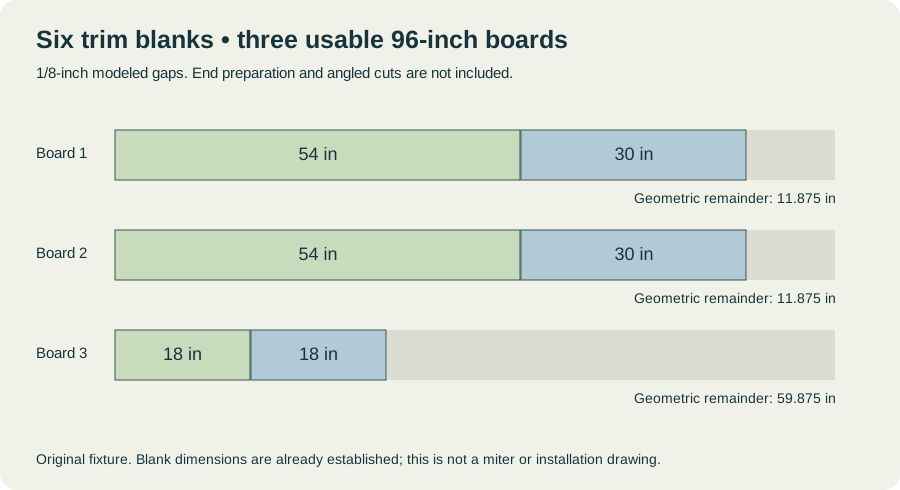
With 96 inches of usable stock and 1/8-inch kerf, the current board engine returns three boards: 54 + 30 on board 1, 54 + 30 on board 2, and 18 + 18 on board 3. Each pair has one modeled kerf gap. The occupied spans are 84.125, 84.125 and 36.125 inches.
The geometric remainders are 11.875, 11.875 and 59.875 inches. Those are not guaranteed ready-to-use offcuts: the actual cut process may consume additional end material. The total finished blank length is 204 inches, already more than two 96-inch boards, so two boards cannot satisfy this fixture even before kerf.
Use usable stock length, not the shelf label
Enter the actual usable length after accounting for end preparation, damage or other reserved material. The example assumes the full 96 inches is usable; it is not a claim about every board sold as 8 feet.
The linear model separates placed parts by kerf. It does not model angled blade sweeps, shared miters, coped ends, cut order or extra stock needed for clamping. Add or reserve appropriate fabrication allowances in your blank and stock specifications, without counting the same allowance twice.
Keep joints, finish and profile constraints visible
A numerical layout cannot decide where a scarf joint is acceptable or whether a short remainder is safe to hold at your saw. Do not split a required continuous run just to improve the apparent yield. Match profile, finish, material and any required orientation before grouping blanks.
If you want to compare stock sizes rather than plan this trim list, use the separate 8-foot vs 10-foot board comparison. The board cut optimizer assumes unlimited matching stock for the selected length; it is not a live store inventory or price quote.