Edge Banding Allowance: Finished Size vs Cut Size
Calculate panel blank sizes from finished dimensions. Clear diagrams show which banded edges reduce width or length, plus a tape-length takeoff and kerf distinction.
When a drawing specifies the outside finished panel size including edge banding, subtract the applied band thickness on each edged side from the perpendicular blank dimension. If the drawing instead specifies the substrate size, do not subtract it again. State the size convention on every cut list.
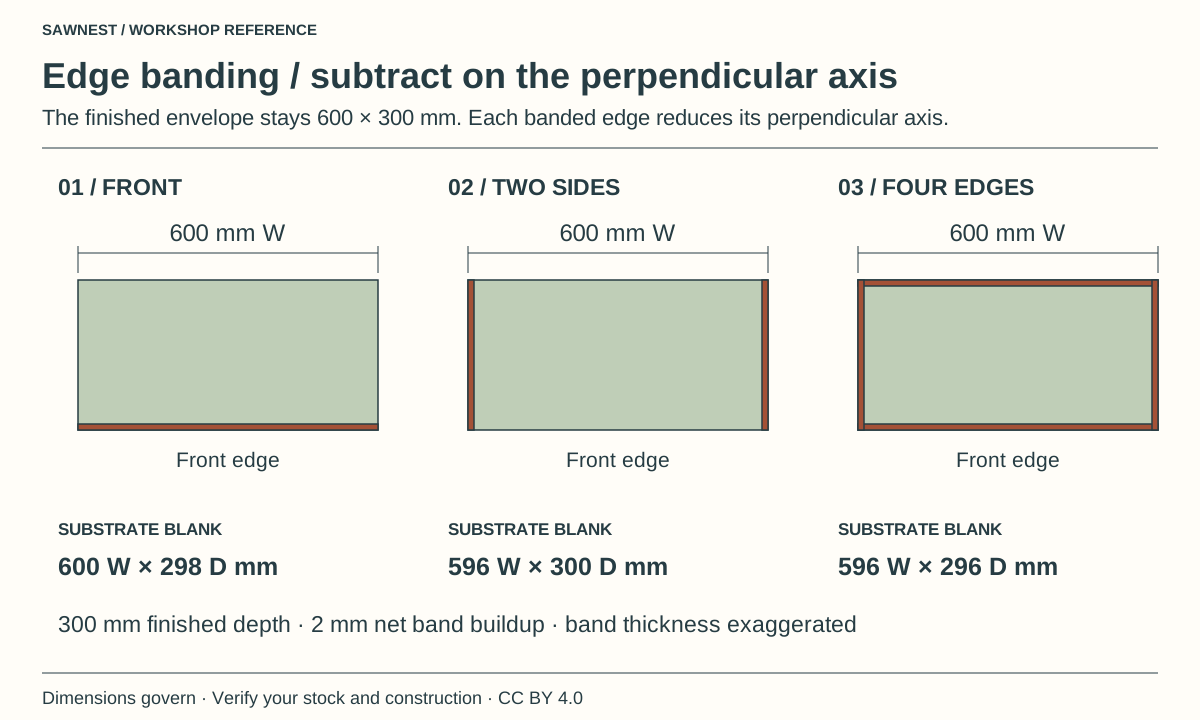
Name the axes and the edged sides
Let W run left to right along the shelf front and D run front to back. Left and right edge bands reduce blank W. Front and back edge bands reduce blank D. A long-edge label alone can be ambiguous, so mark the edges on the drawing.
Blank W = finished W - left buildup - right buildup. Blank D = finished D - front buildup - back buildup. Use measured net outward buildup after bonding and finishing; account for pre-milling separately if the process removes substrate.
Worked example: a finished 600 x 300 mm shelf
Assume net applied band buildup is 2 mm on every specified edge and the desired finished envelope is 600 mm wide x 300 mm deep. These are illustrative dimensions, not a universal tape specification.
| Banded sides | Blank W | Blank D | Why |
|---|---|---|---|
| Front only | 600 mm | 298 mm | One deduction from depth |
| Left and right only | 596 mm | 300 mm | Two deductions from width |
| Front and back only | 600 mm | 296 mm | Two deductions from depth |
| All four sides | 596 mm | 296 mm | Two deductions on each axis |
Band thickness, tape width and trim length are different
Band thickness is the buildup outside the substrate edge. Tape width must cover the panel thickness with the processing overhang your equipment requires. Tape length follows the edge run plus end-trimming and setup allowance. Neither tape width nor extra tape length is a deduction from panel plan dimensions.
For example, a 19 mm panel may need tape wider than 19 mm to allow flush trimming. That does not mean you subtract that tape width from a 300 mm shelf depth. Check the chosen product and adhesive process: REHAU technical data describes different edging materials and processing requirements.
Take off tape length separately
For eight 600 mm-wide shelves with front-only edging, the net front runs total 8 x 600 = 4,800 mm (4.8 m). If your process reserves 20 mm at each end of each strip, allow 8 x (600 + 40) = 5,120 mm (5.12 m), plus a stated reserve for setup and rejects. The 20 mm allowance is an example, not a machine specification.
For all-four-edge work, start with the finished perimeter and confirm the order of application and corner overlap before cutting strips. Do not silently turn a thickness deduction into a tape purchasing allowance.
Send substrate rectangles to the optimizer
Use one clearly named size convention. For the all-four-edge example, the sheet optimizer receives 596 x 296 mm blanks. Enter actual saw kerf separately. Adding kerf to every blank and also setting optimizer kerf double counts blade loss.
Kerf removes stock between blanks; banding adds material to their edges. The saw kerf guide explains blade measurement. Record the edge schedule in the cut-list template and verify one completed test panel before batching. The optimizer does not apply automatic banding deductions.